Software-as-a-Service (SaaS) businesses have become a cornerstone of the modern economy, offering scalable solutions to businesses across various sectors. As SaaS businesses grow, understanding and monitoring key metrics becomes crucial for achieving sustainable success. Financial models for SaaS companies provide the framework for making strategic decisions, attracting investment, and maintaining healthy cash flows. The right financial model helps SaaS founders and operators forecast revenue, manage costs, track performance, and identify growth opportunities. We have also built a ready-to-go SaaS Financial Model Template for Founders looking for an easy-to-use Financial model which will allow them to model out their company’s financials and provide an Income Statement, Balance Sheet and Cash Flow Statement for their SaaS company.
In this article, we explore the key metrics that every SaaS business should include in their financial model. These metrics provide insights into the financial health and scalability of the business and serve as critical benchmarks for performance evaluation.
Monthly Recurring Revenue (MRR)
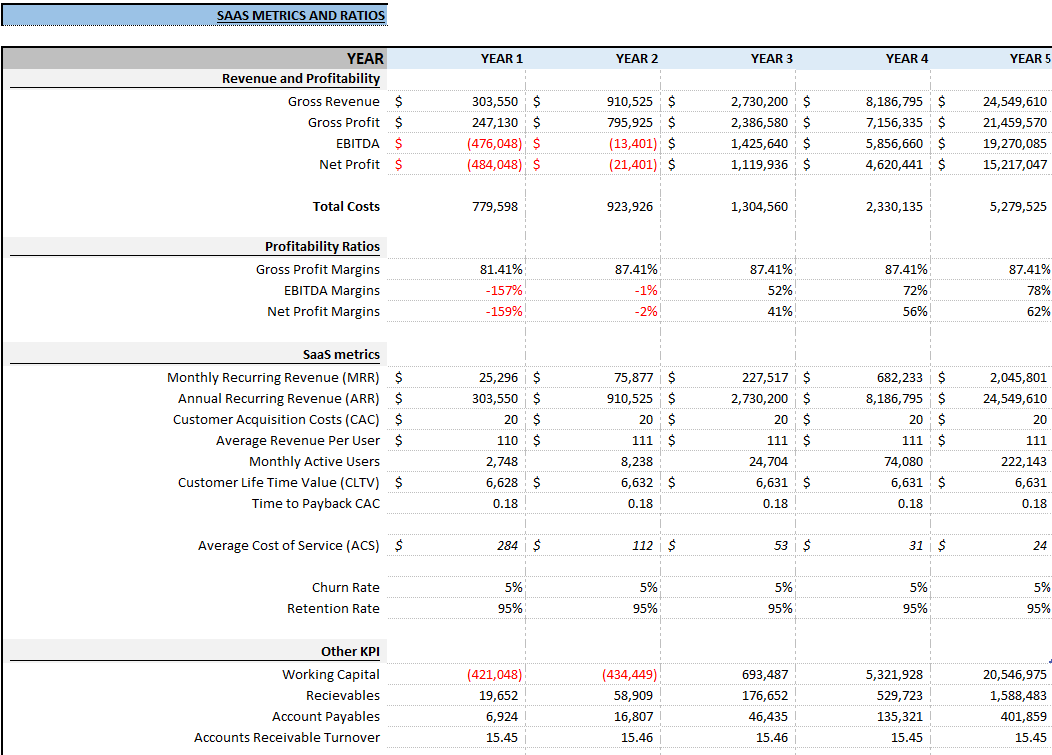
At the heart of a SaaS business model is recurring revenue. Monthly Recurring Revenue (MRR) represents the predictable, recurring revenue generated from customers on a monthly basis. Unlike traditional one-time sales, MRR gives SaaS businesses a clear understanding of their revenue streams and allows them to project future growth more accurately.
- Why it’s important: MRR is the foundation of any SaaS financial model because it reflects the stability and scalability of the business. Tracking MRR helps identify trends in customer acquisition, retention, and churn, which ultimately affect long-term profitability.
- How to calculate MRR: To calculate MRR, simply sum the revenue generated from all active subscriptions in a given month. For example, if you have 100 customers paying $50 per month, your MRR is $5,000.
- Growth Indicators: MRR growth rate is a key performance indicator (KPI) for SaaS businesses, as it indicates the overall health of the business. A growing MRR reflects strong customer acquisition and retention, while stagnating or declining MRR could point to issues with product-market fit or customer satisfaction.
Customer Acquisition Cost (CAC)
Customer Acquisition Cost (CAC) measures the cost of acquiring a new customer. It includes all marketing, sales, and advertising expenses associated with attracting and converting a lead into a paying customer. Understanding CAC is crucial because it helps SaaS businesses evaluate the efficiency of their marketing and sales strategies.
- Why it’s important: Knowing the CAC allows SaaS businesses to assess how much they are investing in acquiring customers relative to the revenue each customer will generate over time. A high CAC relative to customer lifetime value (LTV) can be a red flag for unsustainable growth strategies.
- How to calculate CAC: CAC is calculated by dividing the total sales and marketing expenses by the number of new customers acquired in a specific period. For example, if a SaaS business spends $10,000 on marketing and sales in a month and acquires 100 new customers, the CAC would be $100.
- Growth Indicators: A lower CAC indicates that a company is efficiently acquiring customers, while a higher CAC suggests inefficiencies in the marketing or sales process.
Customer Lifetime Value (LTV)
Customer Lifetime Value (LTV) is a critical metric that predicts the total revenue a business can expect from a customer over the entire duration of their relationship with the company. LTV is a key indicator of the long-term profitability of a SaaS business and helps determine how much a company can afford to spend on customer acquisition.
- Why it’s important: LTV helps SaaS businesses understand the value of retaining customers and provides a benchmark for how much they can invest in acquiring new customers. A high LTV relative to CAC indicates that the business is likely to be profitable in the long term.
- How to calculate LTV: LTV can be calculated by multiplying the average revenue per user (ARPU) by the average customer lifespan.
- Growth Indicators: A higher LTV indicates that the company is generating substantial revenue from its customers over time. When LTV is greater than CAC, it means that a SaaS business can afford to acquire more customers and invest in growth.
Churn Rate
Churn rate refers to the percentage of customers who cancel their subscriptions or fail to renew within a specific time period. High churn rates can indicate dissatisfaction with the product, poor customer service, or a lack of product-market fit. Monitoring churn is essential to understanding customer retention and the long-term sustainability of a SaaS business.
- Why it’s important: High churn rates can negate the positive impact of customer acquisition, leading to revenue loss and difficulty achieving growth targets. Reducing churn is often more cost-effective than acquiring new customers, making it an important metric to track.
- How to calculate churn rate: Churn rate is calculated by dividing the number of customers lost during a given period by the number of customers at the start of that period.
- Growth Indicators: A low churn rate indicates that customers are satisfied with the service and are likely to continue paying over time.
Final Thoughts!
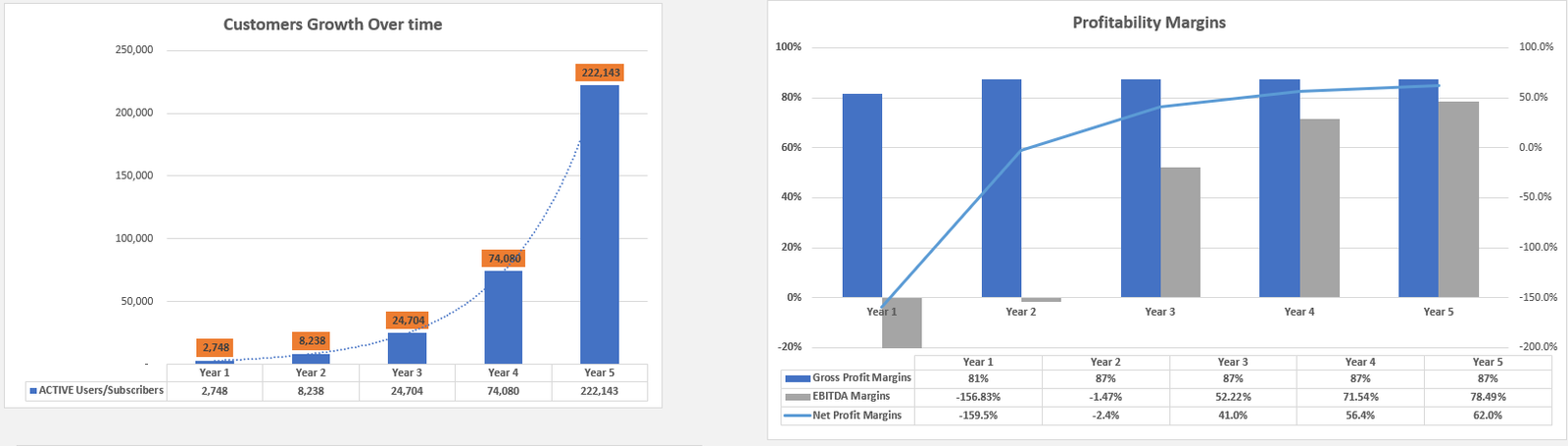
Incorporating the right metrics into your SaaS financial model is essential for driving sustainable growth and making informed decisions. Metrics like MRR, CAC, LTV, churn rate, ARPU, and gross margin provide insights into customer behavior, revenue potential, and operational efficiency. By continuously monitoring and optimizing these metrics, SaaS businesses can refine their strategies and achieve long-term profitability.
FAQs
What is the difference between MRR and ARR?
MRR stands for Monthly Recurring Revenue, tracking the monthly income from subscriptions. ARR, or Annual Recurring Revenue, scales this measurement annually.
Why is churn rate important for SaaS businesses?
Churn rate measures customer retention. A high rate can indicate dissatisfaction, which affects revenue and growth prospects negatively.
How can SaaS companies reduce their CAC?
Reducing CAC involves optimizing marketing strategies, improving customer experience, and ensuring effective targeting of potential leads.